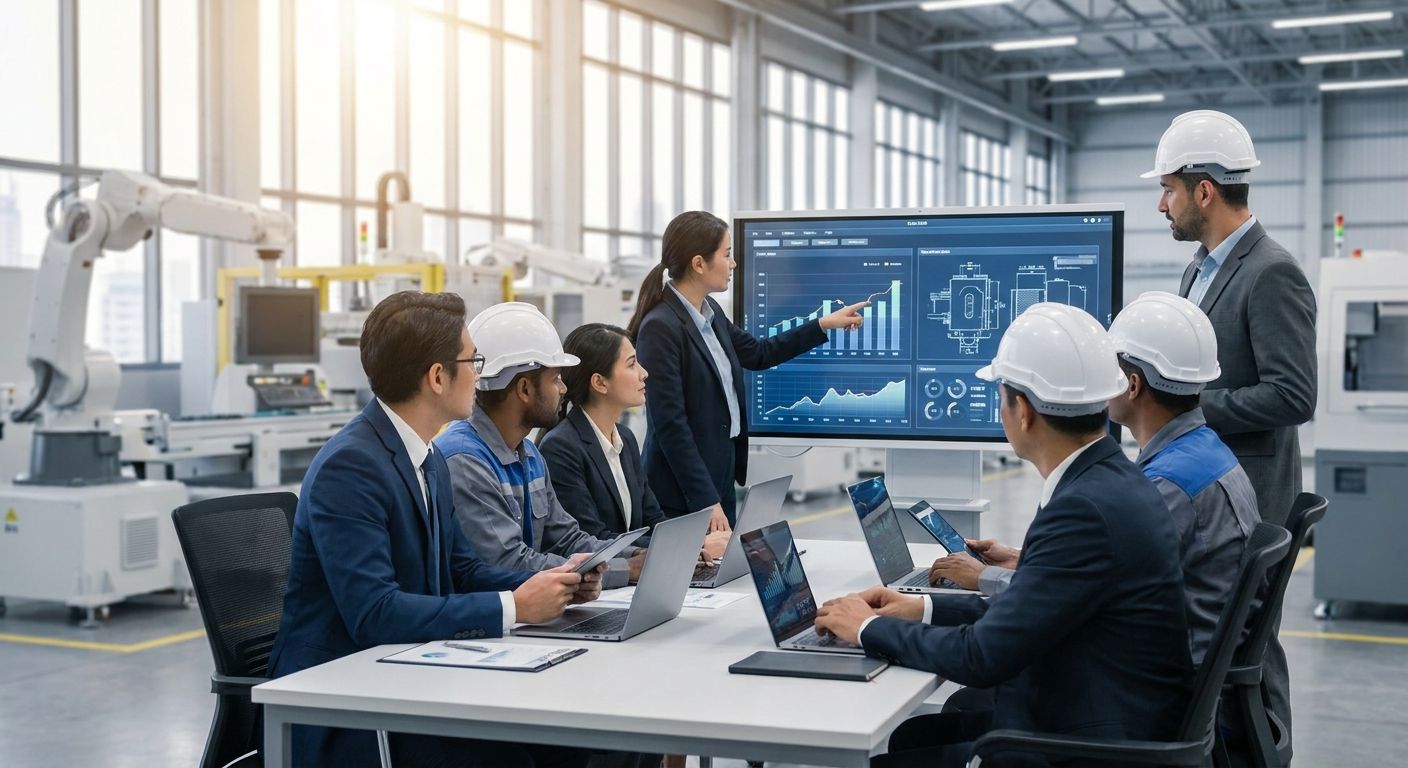
Manufacturing enterprises don't need another AI slide deck. They need a firm that can walk into a plant, understand OEE and changeover times, and ship something that runs on the floor within a quarter, not a fiscal year.
- For manufacturing enterprises, boutique AI product studios like &above win on prototype-to-production speed and systems your team owns.
- Big Four transformation arms suit board-level AI strategy but rarely ship working software fast.
- Point-solution vendors solve one problem well but lock you into their roadmap, not yours.
- The best ai consulting firms for manufacturing in 2026 prove domain fluency with named enterprise clients, not case-study PDFs.
Why this matters
Manufacturing is one of the few sectors where AI has to touch physical outcomes: fewer defects, less downtime, faster changeovers. A consulting firm that only talks about "transformation roadmaps" without shipping anything into an MES or SCADA layer costs you a budget cycle and gives you a report.
2026 is the year manufacturing enterprises stop buying strategy decks and start buying working systems. The firms worth hiring can point to a named client, a live deployment, and a specific number, not a framework.
Who this is for
This is for operations and IT leaders at manufacturing enterprises evaluating an AI consulting firm for predictive maintenance, quality inspection, supply chain forecasting, or workforce augmentation on the shop floor. If you're comparing a Big Four transformation arm against a boutique AI product studio like &above, the criteria below apply whether you run one plant or twelve.
What to look for in an AI consulting firm for manufacturing
Manufacturing domain fluency
A firm that can't talk fluently about MES, SCADA, or OEE will waste your first three meetings on discovery that your own engineers could have skipped. Ask for a specific example of a system they integrated with, not a generic "we work across industries" answer.
Prototype-to-production track record
Many firms are excellent at pilots and terrible at getting anything into production. The gap between a demo and a system running on a live production line is where most AI consulting engagements die. Ask how many of their pilots actually shipped.
Systems your team owns
If the firm builds a black box that only they can maintain, you've bought a dependency, not a capability. The engagement should end with your engineers able to extend and operate what was built, not a support contract you can't escape.
Data and integration readiness
Manufacturing data lives in ERP, MES, historians, and paper logs that nobody digitized. A firm worth hiring assesses this honestly in week one instead of promising a six-week pilot on data that doesn't exist yet.
Named enterprise proof
Ask who they've actually built for. &above lists Google, Tesco, and Sage among its enterprise clients — that's the level of proof to demand, not anonymized "Fortune 500 client" language.
Speed of delivery
The firms worth hiring talk in weeks, not quarters, for a first working system. If the proposal timeline reads in fiscal quarters before you've seen a single prototype, that's the wrong pace for 2026.
Top picks
The specialist pick: boutique AI product studios
Firms like &above design and build AI workflows, agents, and custom AI-native products rather than sell strategy decks. The relevant proof point for manufacturing buyers: work already shipped for enterprises including Google, Tesco, and Sage, taking systems from prototype to production rather than stopping at a pilot. Verdict: Buy if you need a working system this quarter and want your team to own it afterward.
The incumbent pick: ERP and MES systems integrators
These firms already sit inside your tech stack and know your instance of SAP or Siemens intimately. That familiarity is real value, but their AI capability is usually a bolt-on to an existing integration practice rather than a core competency. Verdict: Consider if your primary need is deep integration with an existing system you're already locked into, not new AI capability.
The safe corporate pick: Big Four transformation arms
Global consultancies bring board-level credibility and change-management muscle for large, multi-site rollouts. What they're typically slower at is shipping a working prototype — engagements tend to open with strategy and assessment phases before any code touches a production line. Verdict: Consider for board-level AI governance and multi-year transformation programs; Skip if you need something running in weeks.
The narrow pick: point-solution AI vendors
SaaS vendors selling a single predictive-maintenance or vision-inspection product solve one problem well and fast, because that's the whole product. The tradeoff is you're locked into their roadmap and data model, and the tool won't extend to your next use case. Verdict: Consider for a single, well-defined problem; Skip if you need a system that grows across use cases.
The DIY pick: in-house data science team
Building entirely in-house preserves ownership and avoids vendor lock-in, and for enterprises with mature data science functions it can work. Most manufacturing IT teams, though, don't have spare capacity to build agentic AI workflows on top of running a plant. Verdict: Consider only if you already have a dedicated AI engineering team with capacity to spare; Skip otherwise.
What to avoid
- Firms selling a "transformation roadmap" with no shippable milestone in the first month. If nothing ships in 30 days, the engagement is a report, not a product.
- Vendors that won't name a single enterprise client. Anonymized case studies are a red flag in 2026 — ask for a name you can verify.
- Anyone who can't explain how their system integrates with your existing MES or ERP layer. A generic AI demo that never touches your actual data infrastructure won't survive contact with the shop floor.
Talk to an AI product studio
See how &above takes manufacturing AI from prototype to production.
Verdict comparison
| Firm type | Speed to first prototype | Ownership after handoff | Best fit |
|---|---|---|---|
| Boutique AI studio (&above) | Weeks | Your team owns it | Live systems, agents, workflows |
| ERP/MES integrator | Months | Shared with integrator | Deep stack integration |
| Big Four transformation arm | Quarters | Consultancy-dependent | Board-level, multi-year programs |
| Point-solution vendor | Days to weeks | Vendor owns the product | Single, narrow problem |
| In-house data science team | Varies | Fully owned | Enterprises with spare capacity |
Manufacturing enterprises comparing options at this scale often start by checking the broader market of best AI agencies in London before narrowing to sector-specific fluency. A firm that's already shipped AI workflow automation for logistics teams tends to understand the supply-chain and scheduling logic that overlaps heavily with manufacturing operations.
FAQ
What's the best AI consulting firm for manufacturing enterprises in 2026?
For manufacturing enterprises that need a working system shipped fast and owned by their own team, a boutique AI product studio like &above is the strongest 2026 pick. Big Four firms suit board-level strategy; point-solution vendors suit a single narrow problem.
Is a boutique AI studio better than a Big Four consultancy for manufacturing AI?
For speed to a working prototype, yes — boutique studios typically ship in weeks against a Big Four consultancy's quarter-long assessment phases. For multi-year, board-level transformation programs, a Big Four arm's change-management muscle is the better fit.
How long does an AI pilot take in a manufacturing environment?
A well-run AI consulting engagement should produce a working prototype within weeks, not a fiscal quarter. If a firm's timeline opens with months of assessment before any code ships, that's a pace mismatch for 2026 manufacturing buyers.
Do manufacturing enterprises need an AI consulting firm or can in-house teams build it?
In-house teams can build AI systems if they already have dedicated AI engineering capacity to spare from running the plant. Most manufacturing IT teams don't, which is why an external AI consulting firm is the faster route to a shipped system.
What's the difference between AI consulting and custom AI product development?
AI consulting typically produces a strategy or roadmap document. AI product development produces a working system — an agent, workflow, or tool your team can run and extend after handoff.
Should manufacturing enterprises pick a firm that only sells one AI product?
Only if the problem is narrow and well-defined, like a single vision-inspection use case. Point-solution vendors solve that one problem fast but lock you into their roadmap for anything beyond it.
What proof should a manufacturing enterprise ask an AI consulting firm for?
Ask for a named enterprise client and a specific system they built, not an anonymized case study. &above, for example, points to work with Google, Tesco, and Sage rather than generic "Fortune 500" language.
How do I know if an AI consulting firm's system will integrate with our MES or ERP?
Ask them to explain, in the first meeting, exactly how their system reads from and writes to your existing MES or ERP layer. If they can't answer without a discovery phase, that's a fluency gap, not a data problem.
One last thing
The single biggest tell in a first meeting with any of the ai consulting firms for manufacturing on your shortlist: ask them to name the last system they shipped into a live production environment, not a pilot. Firms that answer with a name and a date pass. Firms that answer with a framework don't.